The World Museum is an institution of scientific curiosity and cultural connection, with a proud history as one of the world's oldest museums. It is a stronghold for our scientific and historic past, continuing to educate its many guests and assisting researchers to solve the biggest problems of our world.
Our goal is to bring the museum into the future by digitising its over 25 million specimens and artifacts. We have developed an efficient and practical digitisation roadmap, with a structured timeline tailored to various object categories. This will ensure a scalable and sustainable transition towards digital transformation.
Strategy
Digitisation is a process where we take information from physical objects and store them in a digital database. This will allow faster and easier access of information to scientists, organisations and communities that need them, as well as improve management of assets, both digital and physical. This is already being done with museums all over the world, and with the World Museum's rich history and collections, this is bound to make a huge positive impact to the communities they serve.
Our digitisation strategy follows eight core business priorities that drive every decision we make. These priorities encompass everything from improving how we track and inventory items to providing broader access, supporting conservation efforts, and deepening cultural engagement. By designing our plan around these goals, we ensure that each object is digitised to a high standard that satisfies our curators, archivists, and community partners. The goal is clear: better tracking and management of objects, wider access for researchers and the public, stronger preservation data for conservators, and richer digital experiences that honor and engage the cultures these artifacts represent.
- Populated Asset Register (Database): A comprehensive digital record of all collection items.
- Location Tracking: Locations of all objects recorded and tracked digitally.
- Standardised Processes: Consistent procedures for asset and information management.
- Imaging: Capture of images, including selective high-quality imaging of objects across collections.
- Context: Enrichment of digital register with research, scientific data, cultural histories, and advanced imagery.
- Conservation: Measures to ensure the safety, security, and quality of physical objects.
- Access: Facilitating digital repatriation and knowledge sharing with the broader community.
- Technology Platform: Implementation of a performant and consistent system for managing digital assets.
The plan is guided by three overarching principles: Tracking & Adaptability, Cultural Sensitivity, and Environmental Responsibility.
Tracking & Adaptability guarantees precise recording of each object’s movements—supporting theft prevention, loan processing, and accountability across our 25 million-item collection—while enhancing our existing barcoding system and allowing room for future upgrades.
Cultural Sensitivity drives collaboration with Indigenous communities, ensuring respect for traditional knowledge, facilitating repatriation or loans when appropriate, and accommodating remote-area fieldwork where connectivity may be limited.
Environmental Responsibility guides our choice of energy-efficient technologies and shapes a low-impact digitisation roadmap, helping us shrink our digital carbon footprint and work toward a carbon-neutral—or even carbon-negative—future. By embedding these principles throughout our process, we balance operational excellence with respect for culture and commitment to sustainability.
Objects
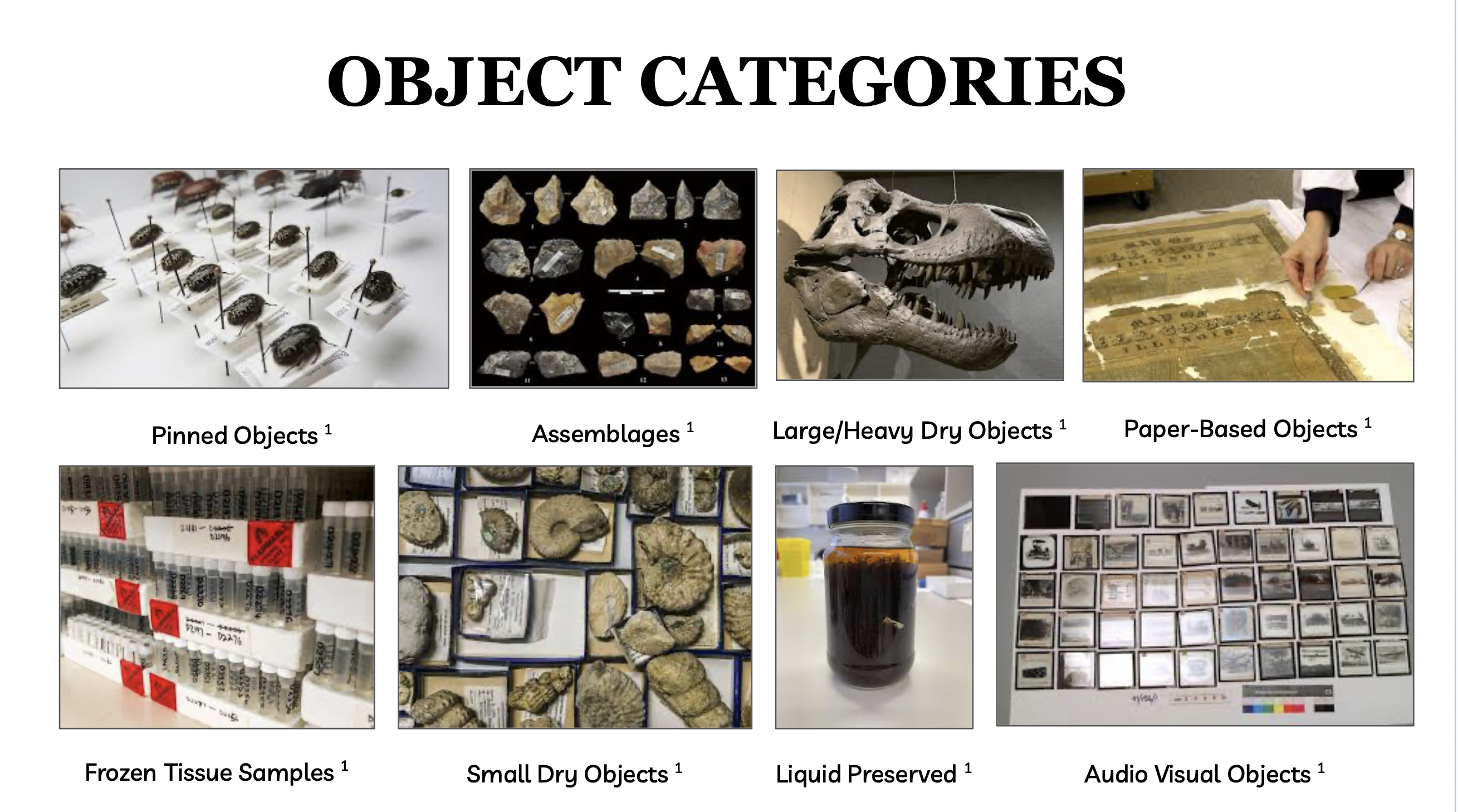
As part of our plan to digitise the museum’s 25 million object collection, these objects have been grouped into eight key categories. To digitise and manage these items, we are focusing on three main technology areas: vision capture techniques, AI and machine learning and sensor-based tracking systems.
Visual Capture
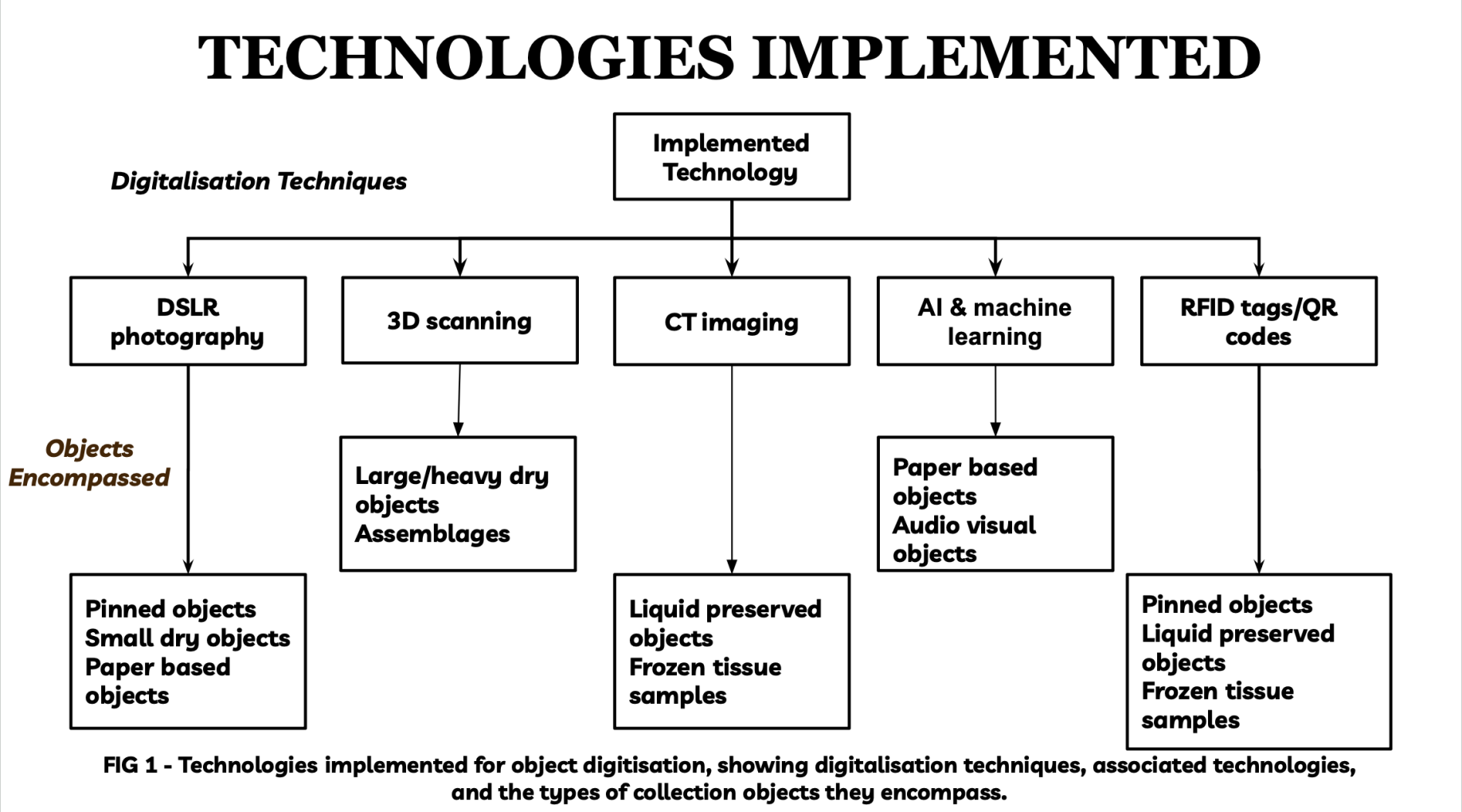
DSLR Photography and Flatbed Scanning: pinned objects, small dry objects and paper-based objects
- Record surface details
- Labels without damaging fragile materials
3D Scanning: large dry objects and assemblages
- Create detailed digital models
- Rreservation
- Future 3D printing
- Restoration and educational use through AR/VR
Photography with CT Imaging: liquid preserved samples and frozen tissue samples
- Photography for external documentation
- CT imaging for internal structures
- Capture the condition of the object without risking damage
Video Transfer: Audiovisual objects
- Outdated media (such as VHS tapes) can be converted into accessible digital formats
- Helping preserve rare or fragile recordings.
AI/ML tools
Image recognition algorithms can help automatically classify objects, flag duplicates or identify labels that are hard to read. AI tools can assist with quality checking, identifying blurred photos or missing metadata.
Character Recognition with Natural Language Processing: paper-based objects
- convert written text into digital text
Sensor-based technologies
Each digitised object will be entered into a central digital asset management system, where its location, condition and digitisation status are recorded.
RFID Tags and QR codes
- Real time location tracking
- Easy registry updates
Technology
Vision capture is at the heart of the digitisation process. It includes methods like photography, video, and 3D scanning, depending on the object type. For pinned, small dry, and paper-based objects, high resolution DSLR photography and flatbed scanning offers cost effective and accurate methods. These tools help record surface details and labels without damaging fragile materials.
Liquid preserved specimens and frozen tissue samples pose unique challenges. Photography works for external documentation but for internal structures, techniques like CT imaging may even be considered. These methods help capture the condition of the object without risking damage.
Audio-visual materials are digitised using video transfer hardware and software. This ensures outdated media, such as VHS tapes, can be converted into accessible digital formats, helping preserve rare or fragile recordings.
Once captured, the vast amount of unstructured data, like images, texts and video will need sorting and analysis. This is where AI and ML tools play a major role. For example, image recognition algorithms can help automatically classify objects, flag duplicates or identify labels that are hard to read. For paper-based records, software such as optical character recognition combined with natural language processing can convert written text into digital texts.
AI tools can also assist with quality checking, identifying blurred photos or missing metadata. Even suggesting object groupings based on visual similarity. To keep track of the 25 million objects across our spaces, we will use sensor-based technologies like RFID tags and QR codes. These allow for real time location tracking and easy registry updates.Each digitised object will be entered into a central digital asset management system, where its location, condition and digitisation status are recorded. This is especially useful for delicate items like frozen samples or preserved objects, where conditions must be constantly monitored.
Special Considerations
Environment
On the environmental side, we are committed to keeping the museum’s carbon footprint low. We plan to use low-energy cameras and equipment for capturing images. All the data will be stored in cloud platforms that already run on renewable energy, such as AWS or Microsoft Azure. These services are carbon neutral and continue to invest in sustainability. Once the data is uploaded and doesn’t need to be accessed often, we’ll move it to a sustainable backup system that uses very little power, helping the museum reduce ongoing energy use.
By combining respect for culture with smart, sustainable technology, this plan protects the collection, supports community ownership and keeps the museum’s environmental impact as low as possible. It is about doing the right thing; both for people and for the planet.
Cultural
Many of the items in the museum’s collection hold deep cultural meaning. For Indigenous communities, these objects are not just artefacts. They are part of living traditions, stories and identity. This means we must treat them with respect. We believe that ethical digitisation means doing more than just taking photos. It means including the people the objects belong to in the process.
Our plan includes working side by side with Indigenous communities to add cultural meaning to the database. We will allow communities to help describe the objects in their own language and from their own point of view. Some objects may need to have limited access to protect cultural knowledge and our system will respect that by using tiered access levels. This gives communities more control and helps build trust.
We also recognise that many of these communities are in remote areas. Because of this, we propose using a mobile app that works offline. It can be used during field trips where there’s no internet. Staff can gather information, stories and context directly from community members and upload it later when they’re back online. This approach avoids the need to move fragile or sensitive items and supports safe, respectful data collection.
Timeline
Our project presents a comprehensive five-year digitisation roadmap tailored to the World Museum’s diverse and complex collection. The plan is carefully designed to balance operational complexity with risk management while embedding cultural and legal considerations from the very beginning.
Year 1
- Establish digitisation teams and protocols.
- Pilot DSLR digitisation for all non-liquid, non-frozen objects.
- Develop metadata standards and a classification system.
Year 2
- Begin 3D scanning Pinned and Small Dry Objects (12.5 million items).
- Scan select Large Dry Objects by dividing them into smaller parts.
- Expand hardware and software infrastructure for digitisation.
Year 3
- Apply AR/VR technologies to digitised data.
- Create interactive experiences (e.g., virtual prehistoric environments).
- Begin virtual exhibition prototyping.
Year 4
- Develop preservation-first strategies for Liquid Preserved and Frozen Tissue Samples.
- Use controlled environments and proxy representations (e.g., digital twins).
- Avoid physical scanning where risk is too high.
Year 5
- Finalise digitisation of all accessible objects.
- Launch public-facing digital platform with search tools and AR/VR experiences.
- Collaborate with cultural and educational institutions for broader impact.
With an estimated cost range of $3.5–5 million AUD over five years. During the Digitisation Setup phase, costs are moderate. Investment is directed toward essential equipment such as DSLR cameras, scanning devices, software licenses, and comprehensive staff training. This early groundwork delivers high-quality outcomes, with DSLR and 3D scanning ensuring detailed and accurate representations of objects. Timewise, the setup phase spans Years 1 and 2 and requires thoughtful planning to onboard staff and establish technical protocols without overwhelming resources.
The 3D Scanning Phase introduces higher costs due to the need for specialised scanners, powerful computing infrastructure, and expanded digital storage. However, the returns in quality are significant—3D scanning enables precise modelling of objects, supporting future-proof archiving and even physical restoration. From a time perspective, this phase is the most demanding, as scanning millions of objects is inherently labor-intensive and must be spread across multiple years to be feasible.
For AR/VR Development, costs range from medium to high depending on the extent of custom development and external expertise required. The quality payoff is substantial, as immersive technologies create engaging educational and outreach experiences that can bring museum collections to life. Development begins in Year 3 and requires careful scheduling to ensure proper testing, iteration, and refinement over time.
Preservation Costs remain moderate, largely focused on establishing and maintaining controlled environments and materials suitable for sensitive items such as liquid-preserved or frozen tissue samples. These costs are essential for protecting items that cannot be fully digitised. While critical in importance, preservation activities are more flexible in timing and do not follow the core digitisation schedule, allowing for ongoing implementation as needed.
The final stage, Public Platform Development, involves medium investment in hosting solutions, content management systems (CMS), user interface design, and cybersecurity. This stage delivers high-quality outcomes by enabling global access to the digital collection and fostering collaboration and user satisfaction. In terms of timing, the platform can be launched in phases during Year 5, with iterative enhancements based on user feedback and analytics. Together, these cost, quality, and time considerations form a strategic framework that ensures the World Museum’s digitisation project is both impactful and sustainable, delivering exceptional outcomes while managing resources effectively.
Risk Management
Our digitisation roadmap incorporates a comprehensive risk mitigation strategy to ensure the safety, integrity, and inclusivity of the World Museum’s collections throughout the project lifecycle.
To prevent object damage, we will implement strict handling protocols, non-invasive imaging techniques, and extensive staff training programs. These practices ensure fragile items are digitised safely without compromising their physical integrity.
To safeguard against data loss, we will use a combination of secure cloud and local backups, implement version control systems, and conduct routine data audits to verify the integrity and consistency of all digital assets.
We take cultural and ethical sensitivity seriously. Our approach includes early and ongoing consultation with cultural and legal advisors to ensure respectful representation and use of digitised materials. We will also enforce digital content usage guidelines to prevent misuse and promote responsible access.
To address scanning limitations, especially with complex or delicate items, we will conduct small-scale trials and ensure regular calibration of imaging equipment. This approach allows for adjustments before full-scale digitisation, ensuring consistent quality.
Preservation challenges are met with approved conservation environments for sensitive items, such as liquid-preserved or frozen tissue samples. These environments support safe storage and handling during digitisation.
We proactively manage cybersecurity threats by enforcing strict access controls and securing sensitive assets with watermarking and encryption protocols. This protects both the collections and the digital rights of associated communities.
Finally, we prioritise user accessibility by testing AR/VR experiences across diverse user groups and adhering to universal design standards. This ensures the digital archive is inclusive and navigable by people of all abilities.
By embedding these layered strategies, we ensure that our digitisation initiative is not only technically robust but also ethically grounded and inclusive, aligning with global best practices in digital heritage management.
Resources
- PwC Australia. (n.d.). Client briefing pack: The World Museum. University of Adelaide. Available at: https://www.adelaide.edu.au/learning/ua/media/2923/pwc-australia-client-briefing-pack-the-world-museum-002.pdf
- Australian Museum. (n.d.). Australian Museum. Available at: https://australian.museum
- Museums & Galleries Queensland, 2021. Ten pointers and sources to help navigate digitisation for small to medium-sized museums. [pdf] Available at: https://magsq.com.au/wp-content/uploads/2021/02/Ten-pointers-and-sources-to-help-navigate-digitisation-for-small-to-medium-sized-museums-003.pdf
- Museums & Galleries of NSW, 2020. Crystal clear: Standards and guidance for digitising regional collections. [online] Available at: https://mgnsw.org.au/sector/resources/online-resources/digital/crystal-clear-standards-and-guidance-for-digitising-regional-collections/
- Museums & Galleries of NSW, 2023. $1.6 million to digitise regional collections. Available at: https://mgnsw.org.au/articles/16-million-digitise-regional-collections/
- Museums & Galleries of NSW, 2023. Six regional NSW hubs funded to bring collections to life. Available at: https://mgnsw.org.au/articles/six-regional-nsw-hubs-funded-to-bring-collections-to-life/
- Taylor, L. (2008). The management of restricted Aboriginal objects. reCollections, 3(1). Available at: https://recollections.nma.gov.au/issues/vol_3_no_1/notes_and_comments/the_management_of_restricted_aboriginal_objects
- Deacon, H. (2004). Intangible heritage in conservation decisions: The implications of a values and rights-based approach. International Journal of Intangible Heritage, 1, pp.61–71. Available at: https://www.ijih.org/volumes/article/47
- Atlas of Living Australia. (2011). South Australian Museum digitisation project: Final report. Atlas of Living Australia. Available at: https://www.ala.org.au/wp-content/uploads/2011/10/South-Australian-Museum-digitisation-project-final-report.pdf
- Zhu, J. (2016), ‘Reflections on Key Concepts of Museum Digitisation in China’, Palace Museum, 4 August, viewed 6 June 2025, https://www.dpm.org.cn/study_detail/100204.html.
- Zhang, J. (2023), ‘Bringing Cultural Relics to Life: Advancing the Digital Display of Heritage’, China Culture Daily, 7 March, viewed 6 June 2025, https://www.mct.gov.cn/preview/special/2023lh/9684/202303/t20230307_940283.htm.